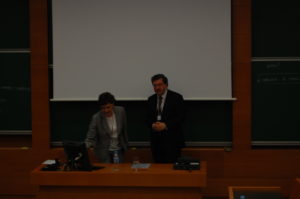
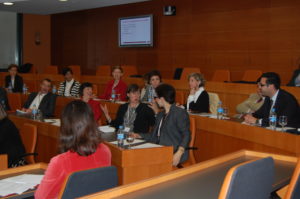
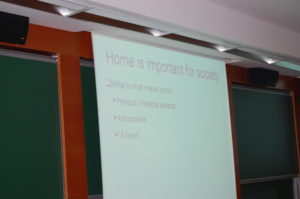
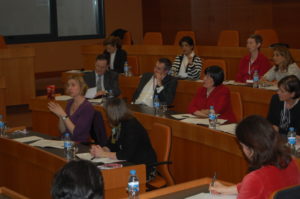
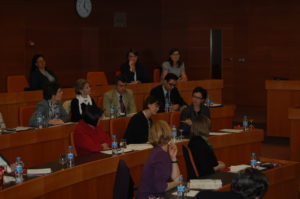
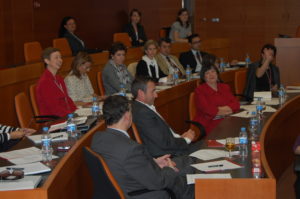
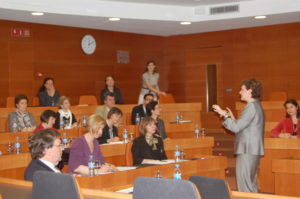
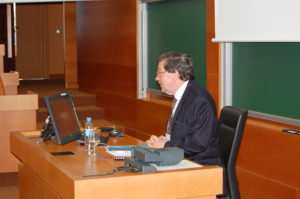
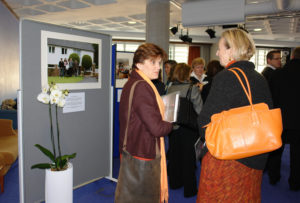
3rd HRF Conference 2011 | Sustainable Living #Day1

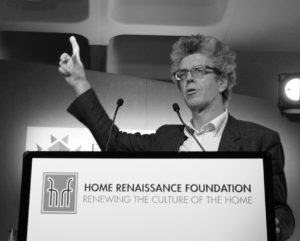
Housework is a dirty word in more ways than one when the work of the home should be valued as a vital building block of a healthy society and a key resource to inform such wider issues as how to reduce waste and carbon. A distinguished panel of speakers at the Sustainable living: Professional Approaches to Housework conference discussed the negative image of housework and how it can be given a 21st-century makeover to rid it of the negative connotations in modern culture of “drudgery”, “repetition” or of “women chained to a kitchen sink”.

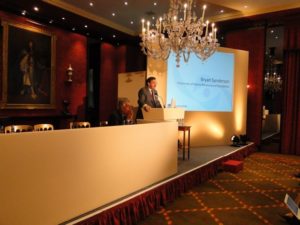
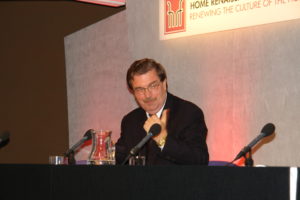
Chairman of the Home Renaissance Foundation Bryan Sanderson CBE said that the role of housework in our society needs a fundamental rethink in order for it to be recast as a professional activity and a valuable resource that can contribute greatly to debates of sustainability. “The word housework does not have good connotations in the world,” said Sanderson who is a former managing director of BP and chairman of Standard Chartered Bank, BUPA and the Learning and Skills Council. “For the work in the home to be recognised as a vital part of our society there will need to be much thought, study and discussion, which does not happen very often.”

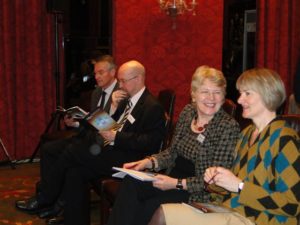
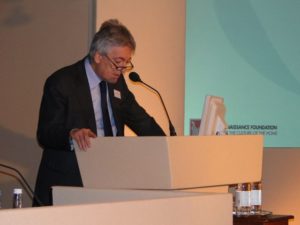
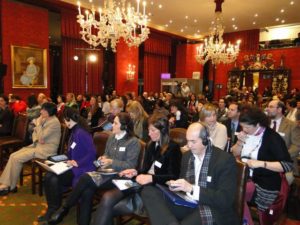
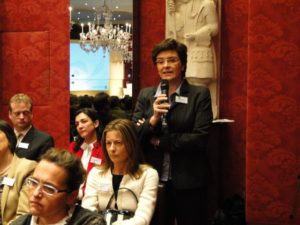
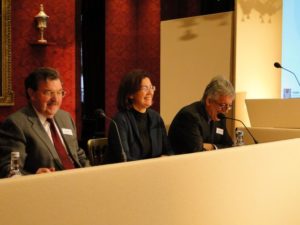
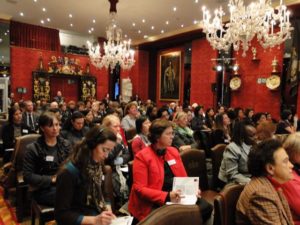
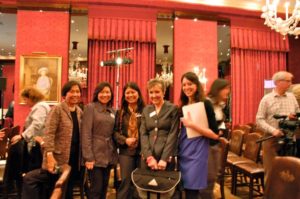
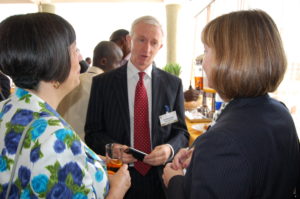
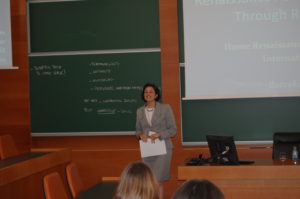
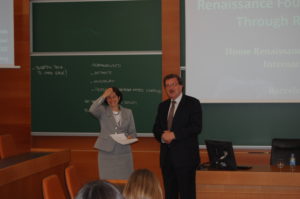
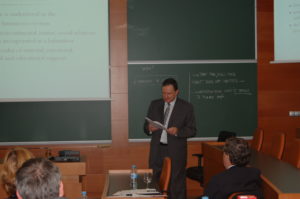
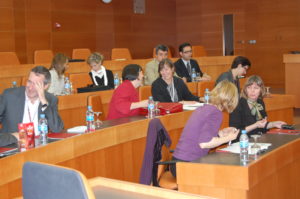
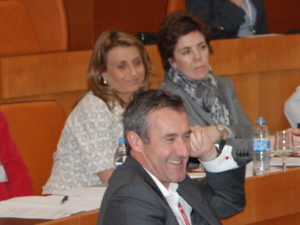
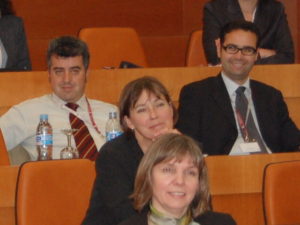
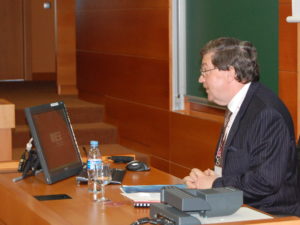
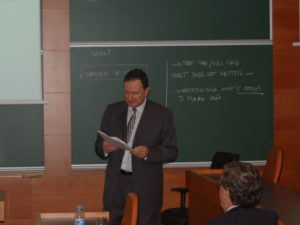
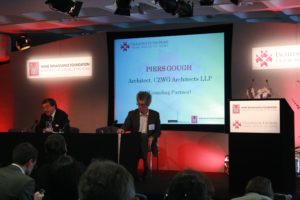
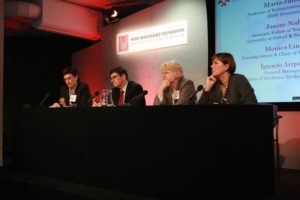
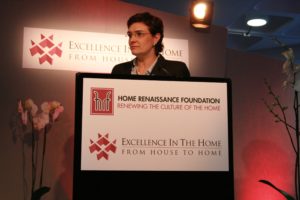
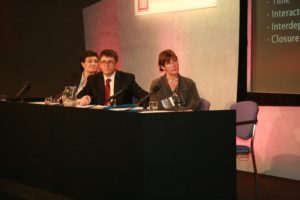
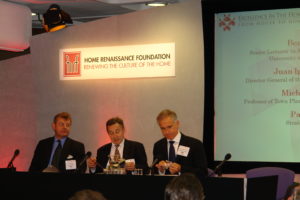
A distinguished panel, including academics, economists, business executives and journalists, gathered at the third Home Renaissance Foundation conference at the Grocers’ Hall, London on March 17 to discuss how to turn this negative perception around. The first solution, presented by Professor Sergio Berlandelli of the University of Bologna, was for modern culture to put more emphasis on the family and the home as opposed to the individual. “The dominant culture at the moment sees the home as a private matter and not a prominent part of building a healthy society even though it has a crucial role to play,” said Berlandinelli who teaches on the history of sociological thought. “A huge part of the resources of society depend on the family and the home yet we consider the home as if it were simply a place of cooking and cleaning.” While acknowledging some of the benefits that the neo-liberal society places on individualism, such as “an end to the subjugation of women”, he also emphasised some of the great costs to a society that places less value on family ties. “People find it more difficult to have settled social relationships with themselves and others.

Young people have no sense of belonging to something or someone and no feeling of upbringing. They do not feel that they have anything significant to pass on and are rootless.” He called for a rebalancing in favour of the family and the home: “If it is true that the human being must be at the centre of every society and that the family represents the best environment in which this person grows and develops independence and social potential, then it is necessary to ensure that work carried out by family in that respect is also recognised and promoted socially. The family must not be left alone.”

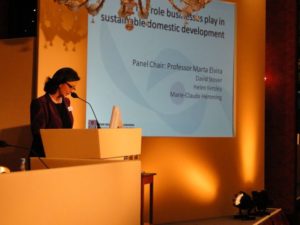
Helen Kersley, a researcher in the Valuing What Matters Team at the Left-leaning thinktank the New Economics Foundation, suggested that all working people in the UK should be employed for 21 hours a week, enabling the amount of available labour to be shared out and giving everyone enough time to concentrate on important work of the home and family life. The work of the home is a “core economy” that needs to be more rewarded, she said. “We need to rethink the system of value that we attach to that core economy,” she said. “We need to rethink the distribution of work and time. If we can underpin the core economy we can prevent social problems from arising and we can prevent a very high bill later down the line. The family and the community are so fundamental to our society but we have a system that only rewards market activity.”

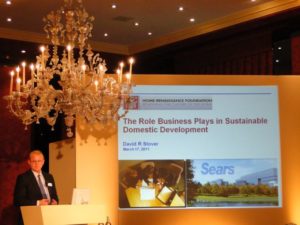
David Stover, Vice-President of Information Technology Transformation at Sears Holdings – a $45 billion business that runs retail operations in more than 4,000 locations in North America – argued that market forces, and not the state, would work in favour of improving homes and the work of the home in future because, as consumers, householders are increasingly powerful. “The household directs the rules of engagement with business,” he said. “The head of the household chooses who to interact with and how. Through advances in IT businesses and retailers can have a more intimate relationship with householders as in days gone by when householders would use the store on the street corner for all their domestic needs. The big companies that do not adapt to this will die.”

Marie Claude Hemmings, a policy adviser at the Federation of Small Businesses, spoke of the need for labour markets to show even greater flexibility to enable more homeworking and thereby free up time for the work of the home. In the UK, promises of better broadband coverage need to be delivered, she said.

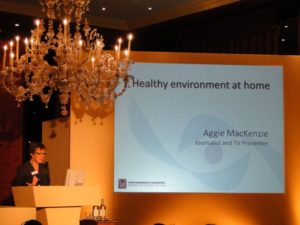
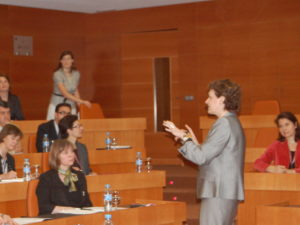
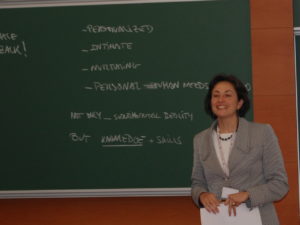
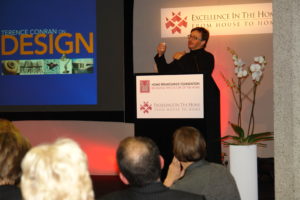
The journalist and presenter of Channel 4’s How Clean is Your House, Aggie Mckenzie addressed the more practical question of how housework can be transformed from a “necessary evil” (a phrase that was challenged by some of the delegates) for the person actually doing it. She shared with the audience some of her experiences on the show of engaging with families where mess had built up and the parents had “given up”, creating misery and chaos that contribute to the health and social problems that the NHS and other agencies spend billions of pounds dealing with. She called on families in the home to all “muck in together” and that housework could be fun. “Something often has to give in our busy lives and it’s often housework,” she said. “We should teach our children early on how to clean and tidy and be rigorous about it; everyone in the household needs to muck in,” said Mckenzie who added candidly that she had failed in this in regard to her own children and that woman in general are still doing the majority of housework in the home. She concluded by presenting her idea of a happy household where everyone is engaged in the war on dirt, mess and chaos. But, she added: “Having a military regime of making your house a germ-free zone doesn’t help either. It should be clean enough to be healthy but dirty enough to be happy.”

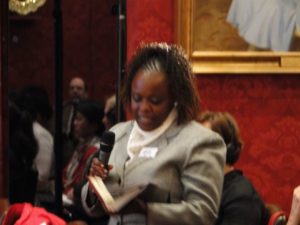
Delegates then shared their own experiences of how housework could be turned into valuable work in its own right and how it does not have to be overwhelming and repetitive provided it is approached with good organisation and like a professional job. Above all, delegates heard that no work is so important that you can’t read your child a story or spend time with your spouse. Mckenzie asked one super-mum delegate, who has 12 children, to share how she and her husband organise the housework. Her stories, which included one about the days when the family’s two washing machines are reserved for only socks, made delegates laugh but were also greeted with spontaneous applause.
Talent Management Conference 2010 at Lagos Business School | Nigeria

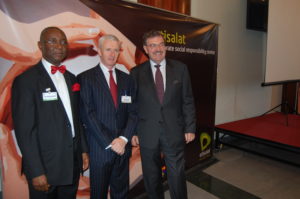
Back in January HRF announced that Chairman Bryan Sanderson, and Directors Teresa Payne
and Mercedes Jaureguibeitia had been invited to participate in a series of CSR related events taking
place in Lagos Business School, Nigeria. By inviting representatives from the Foundation, the
organisers hoped to encourage participants to address the current knowledge gap within this topic.
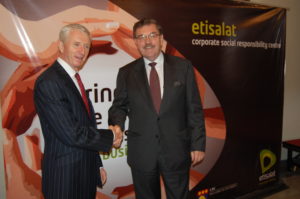
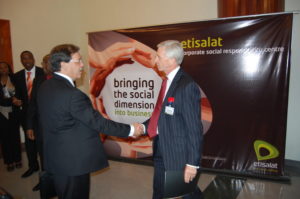
The events, which were hosted by the Etisalat Center for Corporate Social Responsibility of
Lagos Business School, took place in late September (2010) and consisted of a CSR conference, a CEO
Forum and a Talent Management conference. Despite targeting different audiences and
approaching the topic from different perspectives, the Foundation was given exposure at each of the
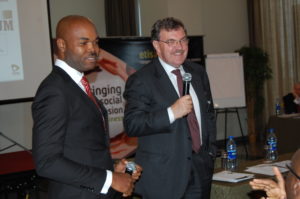
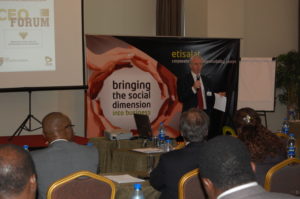
three events. Mr. Sanderson was asked to deliver the keynote address at both the CSR conference
and the CEO Forum as well as give a joint presentation with Teresa Payne at the Talent Management
conference.

These contributions allowed HRF to voice a message at the very heart of the Foundation’s
mission: the direct link between looking after an individual’s basic human needs and effecting
societal change geared towards creating a more humane society. At the CSR conference, Mr.
Sanderson spoke mainly in terms of macroeconomics and gave global examples of the potential
benefits of CSR and in doing so he created a parallelism between the influence a company can have
in the world and the contribution of the home to society. This theme was later developed by Ms.
Payne in the Talent Management conference where she drew from her own professional experience
as partner of a law firm to argue that a happy, healthy and balanced employee is a productive
employee. The best investment a company can make towards its own growth and sustainability,
therefore, is to look after the well-being of its employees.

As a catalyst for change, HRF presents the work of the home as work that has the potential
to define a society. There are, undoubtedly, many different ways in which this work can be seen as a
crucial element to the inner workings of a society and at these events the context was almost purely
corporate. Of course, as a Business School LBS had invited the representatives from the Foundation
to speak about the work of the home in light of CSR rather than from an anthropological perspective
and the links between the two were not entirely evident at the outset. Interestingly, however, the
participants made the connection themselves and one of the participants even proposed that ‘the
first CSR is the home.’

The response HRF’s messages generated in LBS demonstrates that the Foundation has a
strong universal mission that resonates with people from all walks of life. It also highlighted the fact
that the way our mission takes shape practically and the ways in which we act as a catalyst for
change vary from place to place and person to person. International meetings such as this recent
visit to Nigeria are evidence of the richness of international knowledge sharing on the subject of the
work of the home and are, we hope, an excellent springboard for international participation at the
2011 Sustainable Living conference.

Press Contact: 
Media Contacts: Ángela de Miguel
Email: press@homerenaissancefoundation.org
Telephone: + 44 020 7490 3296

HRF Symposium 2009 at IESE Business School | Barcelona

What is the link between home economics and a sustainable society? There are many who would say not much. The three speakers at the Home Renaissance Foundation symposium held in May 2009 in the IESE Business School, Barcelona, had a lot to argue against this general consensus.

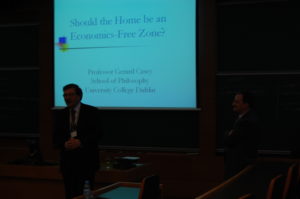
The HRF symposium in Barcelona last May entitled ‘Homemaking and Social Sustainability: Building Society Through a new Professionalism in the Home’ boasted of three academic speakers: Professor Gerard Casey from the School of Philosophy, University College of Dublin, Professor Sophia Aguirre, Associate Professor of Economics at the Catholic University of America and Professor Julia Prats, Head of Department of Entrepreneurship, at IESE Business School, Barcelona. The symposium was held as a preliminary step towards the upcoming Excellence in the Home Conference in London due to take place in 2011.

The first question the speakers tackled was why the connection between the home and fields such as economy, business and politics is not usually made. From a philosophical perspective, Professor Casey reminded the participants in the symposium that a view of economics that divorces economics from the home is not only modern, but contrary to the word’s etymology (the word comes from the Greek words ‘house’ and ‘to manage’). Rather than using this standard model of economics, as the science of wealth, Prof Casey suggested an Austrian model whereby economics is seen as one of the sciences of human action. If economics ‘is to be understood in terms of the logic of human action, of the dynamics of human choice, and of exchange across a range of incommensurable goods, both material and psychic’ then how much of an argument is left for those who argue that the home is an economics-free zone?

From her background in business, Professor Prats contributed to the theme: ‘a sustainable society needs competitive persons: people who are fully developed in every aspect.’ According to Professor Prats the best environment for this development to take place in is the home. This idea was expanded on by Prof Casey, who described the home as ‘the locus for the physical, emotional, and intellectual development of its inhabitants, particularly (but not exclusively) its young.’ He went further, ‘There is no mechanical way of resolving this tension but the home is where this lived tension is initially managed and where the most important things that the new generation needs—the moral virtues—are inculcated.’ Professor Aguirre also contributed to this view by suggesting that the home not only creates the necessary environment for a person to develop and satisfies the need to provide for their basic needs, it is also a manifestation of the interdependence of individuals.

The problem lies in the fact that homemaking is not recognized as a profession and not valued enough within the standard economic model. Prof Prats argued that most of the characteristics that define a profession could be applied to homemaking once the necessary research on the subject has been carried out. We can begin by pointing out that homemaking requires technical competences, such as theoretical and practical knowledge, and skills such as organizational vision, resource management, negotiation skills, and client orientation to name a few. She also went on to highlight the interpersonal competences and personal competences required. Furthermore, as Prof Aguirre pointed out, service is at the core of the work done in the home. What needs to be resolved, then, is whether a homemaker can develop all the possible competences in the professional practice.

This symposium, however, did not merely serve the purpose of expounding academic theory on the topic of homemaking to the group of over twenty individually invited guests. Many questions were posed that remain unanswered at this stage. The result of the symposium was an agenda for the role of academia and the work that must be put into further research on the topic. Professor Aguirre reminded those present that the current research on the topic of homemaking is fragmented and she suggested two goals to work towards: firstly, to understand and define service as captured by the work of the home and, secondly, to achieve a social recognition of this work.

2nd HRF Conference 2008 | From House to Home

London, November 20th & 21st 2008 | The Queen Elizabeth II Conference Centre

As Winston Churchill once said, ‘We shape our buildings and afterward our buildings shape us’. Where we live, that is to say our house, plays a significant role in the development of our lives. It is where our future is moulded, where we learn to live with others, where our values are defined, where we seek refuge, protection and security.

Over the course of the conference, the experts studied this role of the home and the way it might be managed in the future from the fields of architecture, interior design, business studies and homemaking. Delegates from more than a dozen countries gathered at London’s Queen Elizabeth II Conference Centre to answer the question: what makes a house a home?

The focus of architects and interior designers is mainly on the physical aspects of space and design. The concept of home, however, is so much wider. It encompasses anthropological aspects, the management of space and time, the home as a workplace, the home’s inhabitants and its evolution. The economic downturn and modern work tendencies bring with them new trends regarding the home. Homes have become houses that double-up as offices, creating an environment where the two realms, work and family, coexist more and more intensely. It is therefore necessary to respond to this new reality with larger and better structured accommodation in which every member of the family is catered for.

Charles Handy, writer, broadcaster and lecturer, the most influential living management thinker,
believes the home will shortly become “a place where people live, work, eat, sleep and play, a base of operations”. This is due in part to the fact that most people find taking work home with them convenient. It is also more convenient for organizations from an economical point of view: it is an unnecessary expense to provide office space for employees when the majority of the work they do could be done just as easily from home.” This new trend in home design can already be seen in the increasing demand of homes with areas specifically designated for work as well as homes with multifunctional open-plan rooms.

During the Conference, architects were encouraged to think ahead and consider how the ageing
population will alter design. Charles Handy offered the view: “Increasingly, more old people will live at home. Doors will need to be wide enough for wheelchairs”. Furthermore, Mr Handy said that the importance of the home cannot be underestimated and extends to the education of the individual. According to Mr Handy, “The most important school is the home, where you learn consideration for others. You learn about self-discipline much more than at school”.

Other speakers investigated how the physical structure influences the way a home can be created, how the interior and exterior space impacts on an individual’s well-being and development as well as why management skills are critical in the running of a home.
What definitively turns a house into a home is the care of others within that vital space. Without that activity, even when a space encompasses all the physical and aesthetical elements proper to a home, something essential is lacking.

The person can only find fulfillment within the home when the house is ‘made to work’ for them, i.e. when its resources and potentialities are successfully managed for the benefit and well-being of those living there. The home is a space that once constructed needs to be managed.
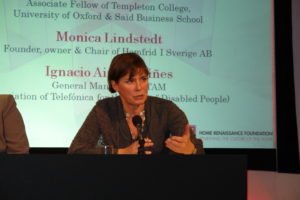
Achieving excellence in the home was a key proposal. Monica Lindstedt founded a Swedish company twelve years ago to outsource housekeeping services. The firm, called Hemfrid – meaning ‘peace at home’ – employs 800 people. Mrs Lindstedt, a working mother, saw a gap in the market created by ignorance of even basic domestic skills among Swedish parents.

Maria Julia Prats, Professor of Entrepreneurial Management at the IESE Business School (Barcelona), offered an alternative to buying in help: training people in home-making. She said homemaking had much in common with conventional professions. Like a doctor, homemakers have a duty to put others before themselves. She is convinced that professionals need a common basis of knowledge in addition to practical – and certifiable – skills, as well as some form of association and social recognition. Professor Lawrence Barth argued for more flexibility in housing policy. He stated “The role of the home is to cultivate autonomy in the next generation…There is a constant search for excellence within it.”

Oxford University’s Janine Nahapiet commented that homes are where children learn how to cooperate, by doing something as simple as solving a jigsaw puzzle together. “The home provides the foundation for relationships,” she said. “Families which are high in social capital have better educational, career and health outcomes.”

In bringing together interested and committed professionals, the second Excellence in the Home
Conference has contributed to interdisciplinary research on home-related issues in the twenty-first century. It is our vision to make the home the place in which each individual is respected and encouraged, thus enabling change in the direction of a more humane society. It is hoped that this research will inform both policy and practice in future.